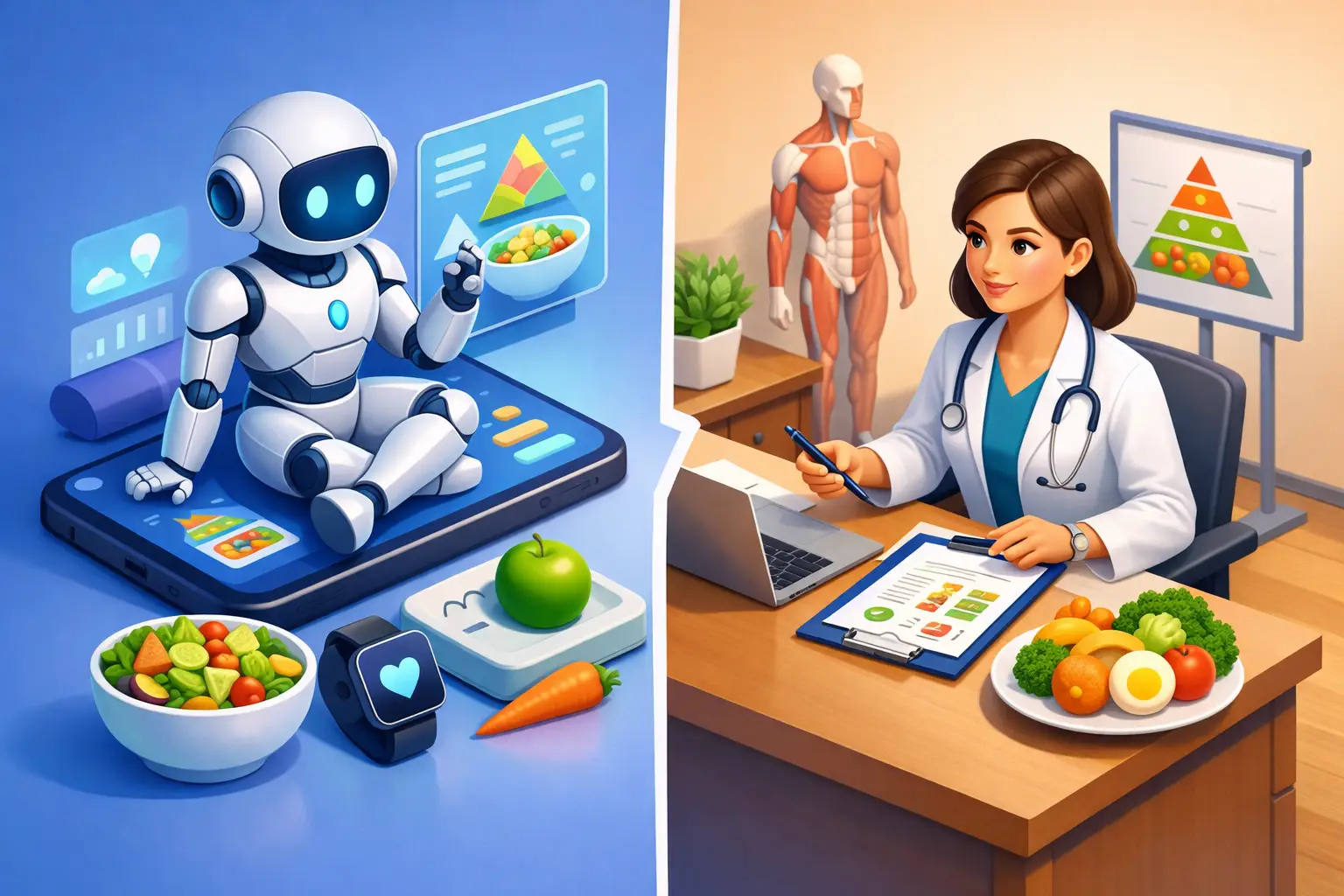
If you've ever stared at the fridge feeling hungry, queasy, tired or just completely out of ideas, the AI nutrition app vs dietitian question gets very real very fast. Not in a theoretical way. In a what-can-I-eat-right-now-that-won't-make-me-feel-worse way. And if you're on a GLP-1 medication, that question can feel even more urgent because your appetite, tolerance and routine can change week to week.
The honest answer is that neither option is automatically better. It depends on what kind of support you need, how often you need it, and whether your biggest struggle is knowledge, consistency or day-to-day decision fatigue.
AI nutrition app vs dietitian: the real difference
A dietitian brings human judgement, clinical training and the ability to spot patterns that matter, especially when symptoms, health conditions or complex medical needs are involved. They can ask follow-up questions, challenge assumptions and tailor advice with nuance. If your relationship with food feels tangled, your symptoms are severe, or you need support that connects nutrition with a wider medical picture, that matters.
An AI nutrition app solves a different problem. It helps in the moments when life is messy and you need fast, practical input. You open your mobile phone, log what is happening, get meal ideas, check your intake, scan a barcode, or work out what to do with the random ingredients already in your kitchen. It is less about a once-a-month appointment and more about support on a Tuesday at 7:15 pm when your brain is done.
That difference is why this is not really a battle. It is more about format than quality. One gives you human expertise in set sessions. The other gives you everyday access and speed.
Where a dietitian is clearly the better choice
There are situations where an app should not be your only support. If you have a medical condition that affects digestion, diabetes management, kidney health, eating behaviour or food tolerance in a serious way, a registered dietitian can be the safer and smarter option. The same goes if you're losing weight too quickly, struggling to eat enough, dealing with persistent vomiting, or trying to balance multiple health issues at once.
This is especially relevant for some GLP-1 users. Appetite suppression can sound simple on paper, but real life is not simple. Some people go from eating normally to forgetting meals, feeling sick after a few bites or only tolerating very specific foods for days at a time. In those cases, you may need advice that is not just personalised but clinically informed.
A good dietitian can also help if you want accountability with emotional depth. Apps can remind you to eat, track patterns and suggest meals. They cannot read your face, notice your hesitation or help you unpack years of food stress in the same way a person can.
Where an AI app often wins
For many people, the main problem is not lack of information. It is friction. They already know they should eat more protein, drink more water or stop skipping breakfast. What they need is help making those things happen consistently.
That is where an AI nutrition app can feel like a relief. It is usually cheaper than private appointments, available every day, and built for action rather than theory. If your challenge is planning meals, tracking what works, spotting patterns around symptoms or staying organised without spending loads of time on it, an app can be a much better fit.
This matters even more if your needs change often. GLP-1 users know this well. One day you can manage a proper lunch. The next day, even the smell of toast is a no. A static plan can quickly become useless. An app that adjusts based on symptoms, appetite and routine can be more practical than advice you received two weeks ago in a perfectly calm setting.
For busy adults who are not on medication, the same logic applies. If you want meal planning without the faff, support without booking appointments, and a simple way to make better choices without turning food into a full-time hobby, digital support makes sense.
Cost, convenience and consistency
Cost changes the decision for a lot of people. A dietitian can be worth every penny, but ongoing one-to-one support is not cheap. For some, that investment is right. For others, it creates pressure to save up questions for one appointment instead of getting help when they actually need it.
An app spreads support across everyday life for a lower monthly cost. That does not make it better by default, but it does make it easier to use regularly. And regular use matters. Nutrition rarely changes because of one brilliant piece of advice. It changes through repetition. Through having breakfast three times this week instead of none. Through noticing that your nausea is worse the day after your injection and planning gentler meals around that.
Convenience sounds boring until you need it. Then it becomes everything. If support lives on your mobile phone and fits around real life, you are more likely to stick with it.
AI nutrition app vs dietitian for GLP-1 users
For GLP-1 users, the best option often depends on whether you need aftercare support, clinical care or both. Medication changes more than appetite. It can affect meal size, food preference, hydration, digestion and confidence around eating. That creates a strange gap. You may not need a full clinical consultation every week, but you do need help far more often than a standard appointment model allows.
That is where a well-built app can genuinely help. Not by pretending to replace healthcare, but by supporting the daily realities that prescriptions do not cover well. Things like symptom tracking, meal ideas that feel manageable, prompts that fit your injection cycle, and simple ways to notice what your body is tolerating.
If you also have red-flag symptoms, a complex health history or need therapeutic nutrition advice, a dietitian should stay in the picture. But if the issue is everyday overwhelm, digital support can take a huge amount of pressure off.
This is also why apps designed specifically for GLP-1 users tend to feel more useful than generic calorie trackers. You do not need another app telling you to eat less. You need one that understands that sometimes the win is managing a few bites of protein and keeping it down. Sillynutrition is built around that kind of real-life support rather than generic diet advice.
The biggest trade-off: depth vs access
If you strip it right back, the AI nutrition app vs dietitian choice usually comes down to one trade-off. Dietitians offer depth. Apps offer access.
Depth is valuable when your situation is complex. Access is valuable when your life is busy, your needs change often, and you need support in the moment rather than next Thursday at 11.
Neither solves everything. An app may be clever, personalised and genuinely useful, but it still works within the information you give it and the limits of digital support. A dietitian may offer expert advice, but if that advice is hard to apply between appointments, it can still leave you stuck at mealtimes.
That is why the best choice is often the one you will actually use. Not the most impressive option on paper. The one that fits your budget, your routine and the kind of support you reach for when things wobble.
So which one should you choose?
Choose a dietitian if you need clinical oversight, have multiple health concerns, want human-led accountability, or feel your nutrition struggles go deeper than planning and tracking.
Choose an AI nutrition app if you want affordable daily support, quick answers, practical meal help and a system that keeps up with your changing routine. It is often the better fit for people who want consistent guidance without turning nutrition into another stressful admin task.
And if you can do both, that can work brilliantly. A dietitian can set the direction. An app can help you live it out in real life.
You do not need to pick the option that sounds the most serious. You need the one that helps you eat, feel better and stay consistent when life is busy, your appetite is unpredictable or your motivation has gone missing. Start there. Small wins count more than perfect plans.